
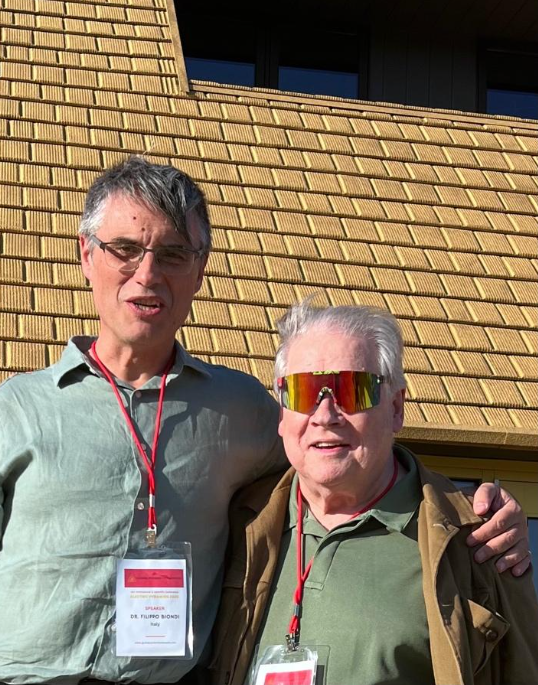
Dr. Filippo Biondi and Chris Dunn at the gold Pyramid House in Wadsworth, illinois
By Christopher Dunn
March 22, 2025
In March of this year, I posted a note expressing my reservations about the recently reported synthetic aperture radar (SAR) scans beneath the Giza Plateau. At that time, the publicly available data were limited, and without direct access to the research team or their methodology, I felt it prudent to be cautious.
Last weekend I presented at the Global Pyramid Conference and while there had the opportunity to discuss the work directly with Dr. Filippo Biondi and to examine additional information he shared. On the basis of that conversation, the supporting data, and further analysis I have undertaken since, my view has changed. I am now convinced that his discovery of deep, spiral-structured columns beneath the plateau is legitimate.
These findings become even more significant in light of the work of Dr. Friedemann Freund of NASA Ames, whose research demonstrates how stressed rock generates mobile electronic charge carriers, which cause a phenomenon commonly referred to as “earthquake lights.” In other words, the Earth itself is an electrical reservoir. The SAR-detected shafts, reaching deep into the igneous rock, appear to be perfectly designed to couple into this geophysical energy source and guide it into the Pyramid above.
When these new discoveries are set alongside what is already documented inside the Great Pyramid — the geometry of the corridors, the slot spacing in the Grand Gallery, and the acoustic behavior of the King’s Chamber — the case for deliberate acoustic engineering becomes exceptionally strong. What once seemed an intriguing possibility has moved, in my judgment, into the realm of near-certainty.
I believe it would now be of great benefit to the world if the Egyptians allow the exploration of the many shafts and tunnels that might exist under the Giza Plateau to gain access to these remarkable underground structures.
I would like to thank the following researchers for providing me with more information on this controversial and complicated subject.
Dr. Filippo Biondi
Dr. Corrado Malanga
Dr. Armando Mei
Dr. Manu Seyzfadeh & ChatGPT
Trevor Grassi